

Pocket Socrates
Why the answer to AI in education is actually a very old idea (combined with another idea only a handful of students benefit from today).


When South Park talks about AI in education, you know it’s a thing. In many ways, comedy can speak truth in a way the rest of us struggle to articulate. But the two of us are going to give it a try…
Let’s make one thing clear up front: Students are not “cheating” on their homework using artificial intelligence tools. They are simply responding to incentives.
What are those incentives? Let’s empathize for a moment and wear the backpack of a 14-year-old high school Freshman. What do they care about?
Being accepted by their peers.
Discovering who they are as people.
Forming friendships.
Getting “benefits” from as many of those friendships as possible. (If that last one offends you, you were never 14.)
The rest of it? The stated reason they’re there? Also known as school? The incentive there is pretty straightforward for most: To get through the rest of the tasks asked of them as quickly as possible so they can get back to 1 through 4.
Until recently, educators had a handle on how to do that. They were good at ensuring students drudged through as much metaphorical mud as possible—usually through long writing assignments, complex mathematics, and endless hours of reading. No, not every teacher was like that, but think about it. In your educational history, how many teachers made the process fun? For most of us, we can count them on one hand. That’s why they’re so memorable.
You’ll notice that the objective of those assignments (learning) doesn't necessarily match the measurement models we most often use (grades, standardized test scores). The latter are proxies for the former. In other words, we hope that the grade reflects the learning achieved by the student. But remember, that has always been an imprecise measure, and its imprecision just got exposed.
ChatGPT can write at any length on any subject in a few moments. It can solve math problems and show the work it took to get there. (The trump card most math teachers love to play.) It can summarize any book with the insight that would have made 14-year-old us even better didn’t-read-it bullshitters. (Both of us were guilty of that. We admit it.)
And why wouldn’t students use AI tools?
They see their parents using the tools to “cheat” at work. They see them using AI tools to fake participation on Zoom calls. Maybe they even see their parents job-stacking—taking two or more full-time jobs because AI can do the work in a fraction of the time.
We aren’t against any of that. That’s what disruption is. Frankly, it’s an opportunity to rethink the broken systems and misaligned incentives that got us to a place no one wants to be.
Speaking of the metaphorical Abeline: Let’s have an awkward and uncomfortable discussion about the state of the educational system in the United States circa 2025. On nearly every measure that matters, performance has declined. A few examples:
Only 28% of 8th graders scored proficient in math on the latest NAEP assessment.
Over 400,000 classrooms are either vacant or filled by educators who do not meet state certification requirements.
48% say the academic performance of most students at their school is fair or poor; a third say it’s good, and only 17% say it’s excellent or very good.
49% say students’ behavior at their school is fair or poor; 35% say it’s good, and 13% rate it as excellent or very good.
Here are the sources (from Pew and Elevate K12) if you want to ruin your day.
And that’s just K-12.
The state of higher education is, in many ways, even worse.
That’s not to say there are not high-performing individual schools, teachers, and students. There are. But an individual is not a system.
Bluntly, AI “cheating” is the least of our problems. What we find interesting is that students have exposed the flaws in the system. They are the disruptors. It’s up to us, as concerned parents and citizens, along with professional educators, to step up to the challenge so that our next generation isn’t lost.
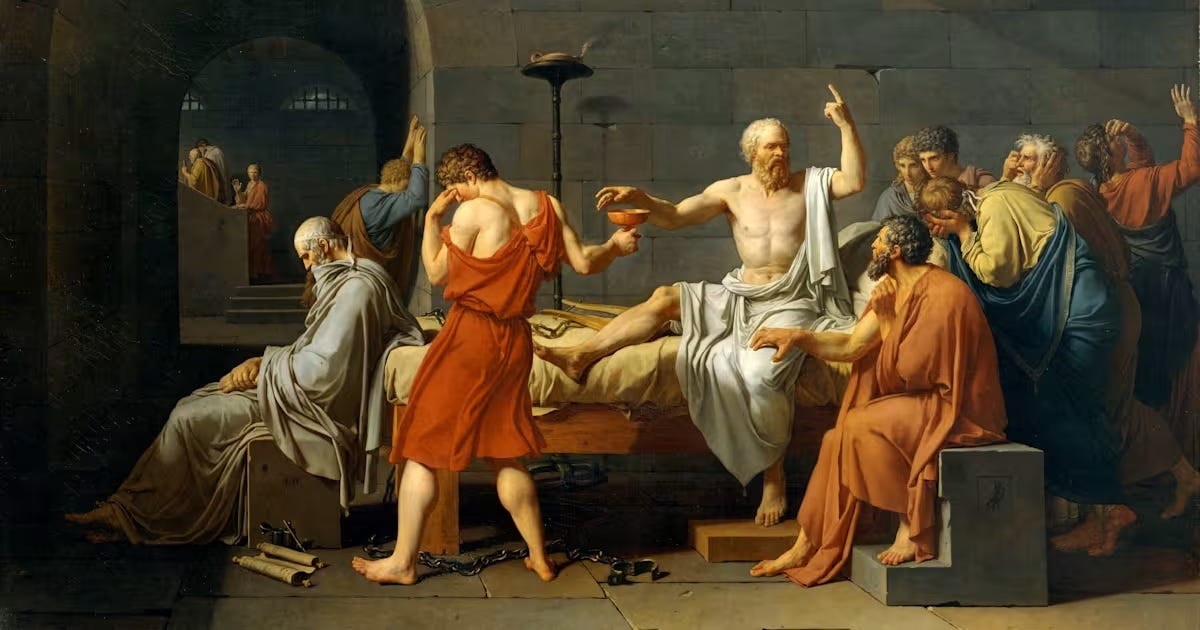
Luckily, we do know what works, and it’s a very old idea: The Socratic Method.
It’s so named for the Greek guy of the same name who used that approach with his students—legends like Plato and Euclid, among others. In other words, he’s kind of a big deal.
The Socratic Method is not a lecture. It’s not an explanation. It is deliberate and strategic questioning.
As Arik would say, the right questions are the most important thing. And as Jason would say, as a professional persuader, you cannot convince anyone of anything. Only they can convince themselves.
Let’s look at an example to help us understand a sticky subject: Parabolic trajectories, and why learning algebra is sort of important.
Q1. When you throw a ball straight up in the air, what shape does its path make?
Student: A straight line, up and then down.
Teacher: Good. Now, what happens if you throw it forward as well as upward?
Q2. If the ball is moving forward at the same time as it’s pulled down by gravity, what kind of curve might the path make instead of a straight line?
Student: It wouldn’t be straight—it would bend downward.
Teacher: Exactly. So it’s not a line, but a curve. Can you guess what type of curve?
Q3. The force of gravity pulls down at a constant rate. If the horizontal motion is steady but the vertical motion accelerates downward, what kind of mathematical function describes that relationship?
Student: A quadratic function?
Teacher: Yes, precisely!
Q4. So if you were to trace the ball’s path through the air, what shape would you see?
Student: A parabola.
Teacher: Correct. Now, where would the highest point of that parabola be?
Q5. And why is that highest point important in understanding the trajectory?
Student: Because it shows the moment when the upward motion stops and the downward motion takes over.
Teacher: Exactly. That turning point is called the apex, and it defines the maximum height of the trajectory.
Pretty cool, huh?
You can use this little trick whenever you want to teach—or persuade—anyone of anything. Simply guide the questions.
It works.
So, if it works so well, why don’t we use it as the foundation of our educational system? Why did we sit through (and often, sleep through) soooooo many lectures?
Because the Socratic Method is not efficient. More to the point, it’s really hard.
As you might guess, it takes a ton of patience and endless one-to-one attention. The problem is that there are only so many Socrates (Socrati? Socractuses?) to go around. In ancient Greece, only the likes of Plato and Xenophon could get this kind of attention. Most everyone else was told to pick up a pike, get in a Phalanx, and charge headfirst into those other guys from another city-state. Education was the privilege of the very few.
Before we continue, a brief moment of self-awareness: Non-educators telling educators how to educate is not going to go over well with some of you…especially educators.
We get it.
Too bad.
Education is an all-hands-on-deck dumpster fire, and if we don’t fix it together, 20 years from now is going to suck. Education as we know it today simply won’t survive.
But before we simply slap a solution on a problem we don’t fully understand, we need to take a step back and understand how we got here.
Luckily, we’re both historians.
(Teachers, you taught us well.)
Let’s go.
Nature’s Teachers
The first thing we need to understand is that the educational process isn’t a human innovation. Plenty of animals do it—if you’re as big a fan of David Attenborough’s nature documentaries as Jason (Arik likes them too, but he’s not as obsessed), you’ll see plenty of examples of parents teaching their young—usually elephants, orca, chimps, and other “big-brained” and social animals. Many of the stories are pretty cool, though one is particularly relevant here: Meerkats.
In meerkat society, parents aren’t the only ones who train their young. Siblings do too. Older (and more experienced) siblings will take charge of a younger sibling and adapt their training to that sibling’s level.
In one example (the video is cool; watch it), you’ll notice the teenage meerkat de-stingering this tasty scorpion so that the youngster can get a handle on dispatching it. As the youngster learns, the mentor will only partially incapacitate it. After that, the mentor will stand by and watch to make sure all is okay.
This is not only a classic learn by doing approach, but also evidence that others in the community can (and should/do) take responsibility for education.
It’s not all on you, Mom and Dad. Even animals have teachers.
(Whew.)
Classical Education
It’s surprising how much education mirrored our animal cousins…basically, “Until Yesterday.”
We’ve already hinted at the Greek model, but in the intervening centuries, the elite and privileged (and occasionally, the very smart) could work their way into a University, Monastery, or Salon.
Not the types of Salons you’re thinking of.
They probably didn’t work on hair and waxing (although their experiments did occasionally get weird). No, these were places where educated people could become more educated, discuss openly (with limits, don’t tell that to Galileo), and build networks and relationships.
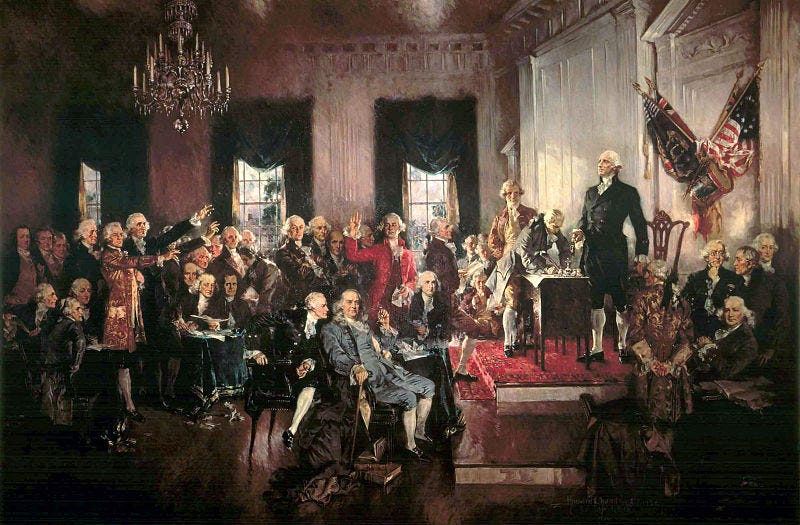
The most famous on this side of the pond were Salons started before the Revolutionary War in the United States, many of which were built on work from Enlightenment thinkers of Europe to give structure to the American idea.
The psychological process at play is now well understood: By concentrating perspective and inquiry in one tightly-knit group, it tends to self-reinforce the learning process. Yes, occasionally, you get a brilliant mind like Isaac Newton who runs off to the countryside during the 1665 plague to invent Calculus and modern Physics. However, most of the time, it’s the collaboration and concentration that matter.
We see the same thing today in the innovation hubs of Silicon Valley (for tech), Boston and New York (for finance), Minneapolis (medical technology), and Miami (culture).
It’s also well known that it can harden positions as well—that’s the downside. In the beginning, it helps, but over time it can calcify habits and norms in a way that makes them ripe for disruption. London was a great example of a fragile financial center at the outset of the First World War.
The American Salon was one of Ben Franklin’s many contributions, and he serves as a good bridge to help us understand a parallel trend in education.
The (First) Apprentice

Most people don’t know this, but one of Ben Franklin’s first “jobs” was being a printer’s apprentice. Basically, that meant learning alongside an existing master craftsperson for a period of time, until you could become a journeyman, and then later, your own master. That’s where the idea of a “masterpiece” comes from, by the way. That is the point in your journeyman career where you finally became skilled enough to take on apprentices of your own.
For the geeky among you, this was the idea George Lucas stole for Star Wars: The Padawan learner (aka apprentice in many iterations—the word Padawan was first used in the Prequels), the Jedi Knight (good, but not entrusted with teaching anyone else), and the Jedi Master (who was).
Where GM and Ford factories of the time relied on process to ensure the line ran smoothly, Toyota relied on people to do the same thing. Initially, when American carmakers attempted to incorporate these techniques, they failed to understand the powerful human pedagogy that underpinned the result.
The bottom line is that, like the Socratic method, apprenticeship works—and can work—extraordinarily well. The bad news is that it rarely scales outside of defined roles. Toyota could pull it off because (in many ways) its production line resembled a medieval guild.
Oh, and let’s avoid the fact that very few people could actually get those opportunities. And that the guilds were insular and resisted progress. And that the Mercantile system that arose around them was an utter failure when competing with modern Capitalism. And that Ben Franklin was forced into servitude at age 12.
Um, yeah.
Today, we’d call that “problematic,” right?
Blame the Germans (technically, the Prussians)

None of this has yet explained how on Earth we largely abandoned all those other ideas—all with their flaws, to be sure—and replaced them with a room with a few dozen students facing a teacher.
The stock explanation is that we copied the Henry Ford model of producing cars to produce students. It was more efficient that way! If only the greedy capitalists weren’t in charge, we’d have great education!
Like most stock explanations, it’s not only wrong, it’s worse than wrong because it’s a lie that leads us down the wrong path to fixing the system. It’s almost as if someone has a vested interest in keeping the education system broken…hmm…we’ll save that for a follow up essay.
It was the Prussian state (a forerunner to Germany) that basically invented the modern classroom in the 1800s: One teacher, multiple students, divided by age and subject matter. Prussia created a unified state out of hundreds of bickering principalities constantly overrun by France, threatened by Russia, and economically bullied by Great Britain. Yes, military education was a big deal, but the Prussian model helped ensure a cohesive set of values for a larger Germany that would be unified by their common tongue in the coming decades.
Put simply: Education creates society.
That’s one of the reasons it’s so important and an aspect of education we cannot ignore in any solution to the challenges that face us. Any educational solution must address the diffusion of shared values.
The German model wouldn’t have caught on elsewhere (especially in the United States) if it didn’t serve a purpose.
Universal education had been a dream of the founders since the early days of the Colonies—especially John and Abigail Adams, who wrote the requirement into the Massachusetts state constitution, which was itself a model for the US Constitution. The problem was that it was expensive and difficult for most citizens who lived in rural areas.
As people moved to cities during the Industrial Revolution, the Capitalists and Industrialists encouraged (and funded) public schools because they needed workers trained in basic skills. Essentially, they externalized part of the cost of educating their workforce.
And just when you thought Progressives didn’t have a hand in this, they also pushed hard—mostly to secularize education—especially in the Great Depression and New Deal. They wanted to take influence away from parochial schools and instill their brand of civic values apart from religion.
In other words, classroom education wasn’t as much about efficiency as it was about promoting collective values.
And the final awkward point…education as day care.
As the nuclear family atomized in the 1950s and 1960s, and especially as women joined the workforce and college in greater numbers, education took on a third critical task: state-run childcare.
In fact, many teachers feel that “babysitting” is their main job—or at least, too big a part of it. Just look at what happened during the pandemic, or frankly, every late August. Parents want their kids to return to school to give them something to do during the day.
If we were being honest and redesigning an educational system from scratch, we probably wouldn’t do it this way. But much like the evolution of any other natural system, education is a messy amalgam of solutions kludged together throughout our long history as society’s needs have changed.
To refresh, those needs are:
Developing skills (best done one-to-one)
Instilling values (best done one-to-many)
Supervising the process of doing 1 and 2 to protect learners from themselves
But then, a grand shift takes place, every once in a while—like the Industrial Revolution—we come to a time where we have the opportunity to do something truly new: Start over.
IEPv2.0: Pocket Socrates
Any parent of a child with an IEP already has a sense of what we’re talking about here. Most special education students have not been able to participate in so-called “general education” classrooms—at least, not completely. That could be because of physical limitations, cognitive limitations, or both.
In short, they get individualized guidance and attention from a team of professionals with a formalized plan known as an Individualized Education Program (IEP).
If you want to read more about how it works, you can find more information here, but the results bear us out.
Special Education, when done according to plan, works very well. So well, in fact, that parents have (responding to incentives to get the best for their child) flooded the system in massive numbers. Getting personalized attention is the key to the miracle of IEPs.
That’s not to say that these aren’t “legitimate” requests (whatever that means), but the reality is that special education is crumbling under the weight. The system was meant to address a handful of kids with Cerebral Palsy, not hundreds of thousands of kids with Asperger’s.
But there is a silver lining.
What would need to be true to not only give kids their own private tutor to work with them individually without ever growing fatigued or frustrated with learners, but also a team of people with a personalized and individualized plan designed to help that student succeed?
Well, you’d need some sort of technology that not only was the repository of all the world’s knowledge, but also a technology that could adapt that knowledge like Socrates to everyone for an incremental cost marginal to zero.
That part is easy. We have that now, and it’s called ChatGPT. In the future, we could program agents to take any number of teaching perspectives—“home room” coordinator, math, science, literature, etc. (Watch the latest demo to get a sense for what this could look like.) They would automatically adapt their plans to ensure that specific student mastered the material and how to apply it in their own unique way.
And if you’re thinking about the approach many educators are taking—the “no tech” approach of hand-written essays and live regurgitation—that’s simply a retreat. It’s like insisting to ride a horse down 5th Avenue in New York in the 1930s. You’ll end up with a a lot of honking horns and a very scared horse.
Assuming educators embrace rather than resist this technology, now comes the much harder part.
We need to rethink what it means to be an “educator”—with a focus on guiding the models, but also with a much more focused approach to developing collective values and individual character. (In practical terms, they’ll have to be good coders too to watch for biases embedded therein.)
Over the past 20 years, as services like YouTube became commonplace, the Khan Academy helped pioneer the idea of “flipping” the traditional classroom by using Internet video lectures to replace homework so educators could focus on working more directly with individual kids in school, applying the lessons to solving problems. While this was a welcome respite for students who hated homework—both hands going up from your authors—it didn’t necessarily lead to better educational outcomes. Indeed, removing homework actually stripped much of the idea of “effort” from our definition of education entirely.
It turns out, the mechanism of action for adolescent human learning is based, not necessarily on great teachers, but on helping students want to put effort into their own education. Arguably, the smartphone revolution that made nearly everything we do almost effortless was no help in helping humans truly learn.
But what if AI, instead of helping students make learning even more effortless, could be concentrated on helping students apply themselves in ways they simply can’t from a human educator? Teachers could then fill the role as orchestrator of student learning, rather than tolerating the diffusion of responsibility we see today, as more teachers than ever decide teaching just isn’t for them. Could all general education teachers act more like special education teachers do today—coordinating and personalizing, rather than standardizing and measuring? And what if students who were challenged, individually, are much less likely to act out and require strict supervision to “keep them in line?”
Interesting questions, aren’t they?
It’s about time we started imagining a world where every student could carry their own version of Socrates in their pocket.
Actually, we better start building it.
We’re running out of time.
For more of Arik Johnson’s work (along with his brother Derek), check out The Missionary and the Mercenary on Substack and Amazon.
 | A guest post by
|